

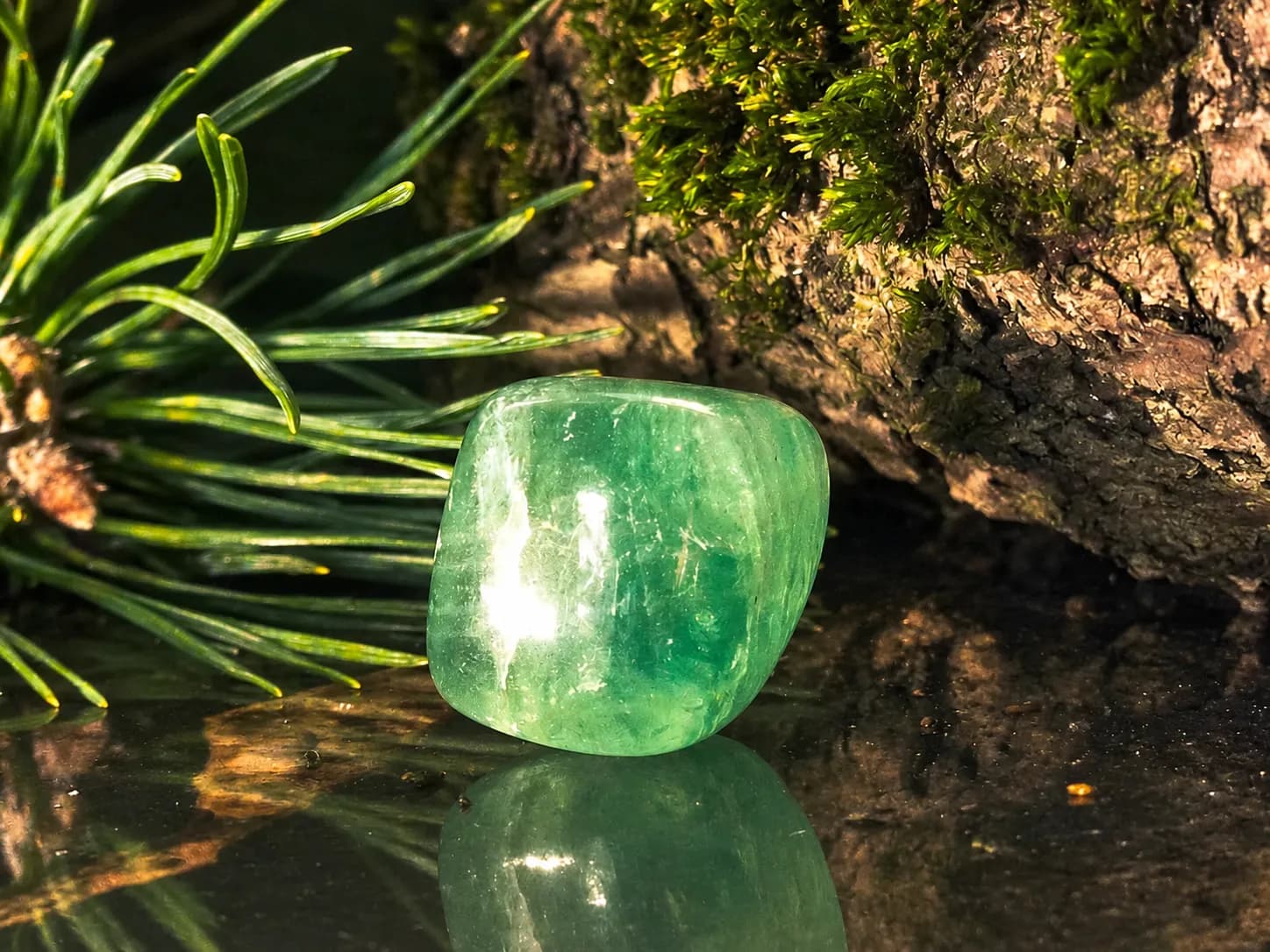
Fluorite: colour bands, hidden light and a gentle touch
Green beside violet, a pale stripe through a darker patch: fluorite rewards a closer look. Some specimens have another surprise under ultraviolet light. Yet colour and fluorescence tell different stories, and neither makes this delicate mineral tougher.
- Composition
- Calcium fluoride · CaF₂
- Hardness
- 4 on the Mohs scale
- Crystal system
- Cubic
- Appearance
- Often colour-zoned; transparent to translucent
One mineral, many colours
Fluorite occurs in purple, green, blue, yellow and even colourless forms. It is found in hydrothermal veins, granites and pegmatites. A polished pebble and a sharply edged crystal can belong to the same mineral species, despite looking quite different.
Impurities and natural radiation contribute to its colours. When several colours occupy different zones of one crystal, cutters can reveal them together in material often sold as “rainbow fluorite”. That name describes the colour pattern; it does not identify a separate mineral species.
A crystal can keep traces of its growth
The Natural History Museum of Utah describes fluorite from Dugway with alternating coloured and white bands. An Illinois specimen holds a different surprise: yellow fluorite enclosed by later pale-blue growth. Such an inner crystal is called a “phantom”. These examples invite a closer look at the boundaries within a stone.
The name itself recalls a practical use. The museum traces it to Latin fluere, “to flow”: fluorite served as a flux in glassmaking and iron processing.
Colour, fluorescence and an afterglow
The Fluorescent Mineral Society explains that minerals can absorb UV energy and release visible light. Small amounts of activating impurities, and others that suppress emission, help determine the colour and strength of that response.
Swipe sideways to see every column.
| Observation | What you see | What to remember |
|---|---|---|
| Colour in ordinary light | Green, purple or other colours and zones | Does not predict a particular UV response |
| Fluorescence | Light emitted during suitable illumination | Depends on the specimen and excitation conditions |
| Phosphorescence | Emission continuing after excitation stops | An afterglow, rather than an automatic property of every fluorite |
A striking recorded example comes from Rogerley Mine in England. Collector Michael Crawford documented green fluorite with bright blue fluorescence under longwave UV and blue daylight fluorescence in sunlight. That specimen demonstrates what fluorite can do; it does not promise the same display from the Nimbas product.
Beautiful, but easily damaged
Hardness describes resistance to scratching. Fluorite is also brittle and has perfect cleavage, so impact damage matters too. A smooth polish is no reason to treat it as a hard-wearing stone.
- Keep it separate. Use a soft pouch or padded compartment rather than a loose pile of stones.
- Avoid ultrasonic cleaning. GIA specifically includes fluorite among gems unsuitable for it because of sensitivity to heat and temperature changes.
- Wipe gently. A soft, lightly damp cloth is a cautious first choice. Avoid soaking, steam and harsh cleaning products.
- Choose its resting place. Avoid prolonged strong light: some fluorites can fade.
Explore the Nimbas fluorite in ordinary light first. Follow its pale lines and colour patches. There is plenty to notice before any special lighting enters the picture.
Sources and further reading
Mineral properties, museum specimens and practical care informed this article.
- Handbook of Mineralogy — Fluorite: composition, properties and occurrence
- Natural History Museum of Utah — What is Fluorite?
- International Gem Society — Fluorite: colour, fluorescence and care
- Fluorescent Mineral Society — Fluorescence in Minerals
- Fluorescent Mineral Society — Rogerley Mine specimen documented by Michael Crawford
- GIA — Tips on Caring for Jewelry


