

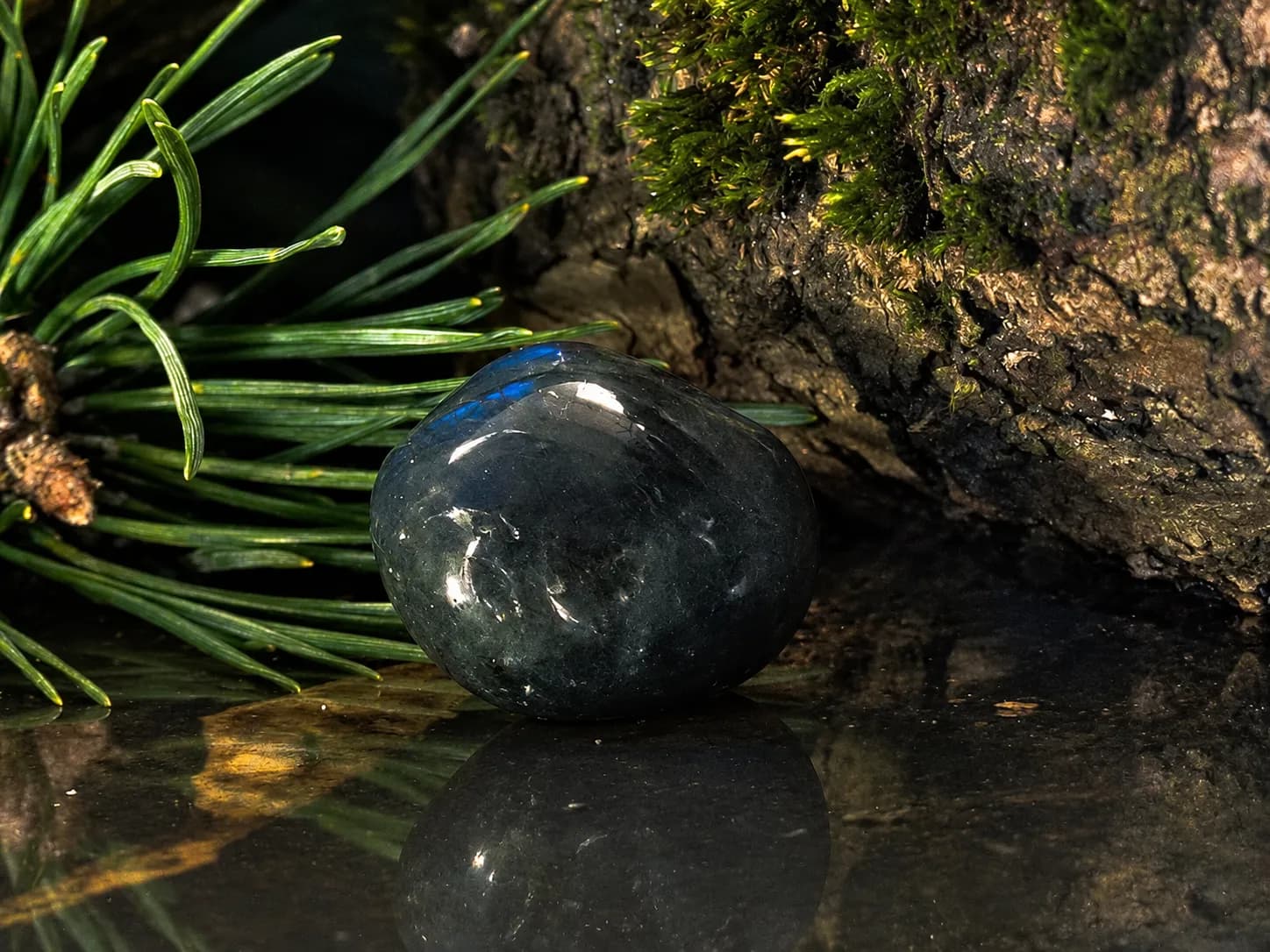
Labradorite: why does a grey stone flash blue?
Labradorite rewards a slow look. From one angle it seems dark grey; from another, a patch of blue or gold lights up across it. Turn it a little further and the colour disappears. The most interesting part of this stone lies inside, well beyond the reach of polishing.
- Mineral family
- Feldspar · plagioclase series
- Hardness
- 6–6.5 on the Mohs scale
- Optical effect
- Labradorescence
- Name origin
- Labrador, Canada
Light meets layers inside the stone
Labradorite belongs to the plagioclase series of sodium- and calcium-bearing feldspars. In gemology, its name describes a particular composition range between albite and anorthite. Composition defines labradorite, so a bright flash is not a feature every specimen must have.
Inside iridescent labradorite, microscopic layers of different compositions alternate. Light interacting with them creates the effect called labradorescence. The colour we see depends on the layers’ thickness and optical properties. A stone can therefore flash blue, green or yellow, then return to quiet grey as the viewing angle changes.
From Labrador to Australia
The name comes from Pauls Island off the coast of Labrador, Canada, its type locality. That connection also survives in official symbolism: labradorite became the provincial mineral of Newfoundland and Labrador in 1975.
A name alone does not tell us where a particular stone was mined. Labradorite also occurs in Finland and Madagascar. The Australian Museum describes another appearance altogether: transparent yellow labradorite from New South Wales and Queensland, which can be cut into faceted gems.
A dark stone with a blue flash is therefore only one side of the story. A photograph cannot reliably establish a specimen’s country of origin or specific trade variety.
Three names that can cause confusion
Trade names sometimes overshadow mineralogy. Here is how three common names relate to one another.
Swipe the table sideways to see every column.
| Name | What it means | What to look out for |
|---|---|---|
| Labradorite | Plagioclase within a particular composition range. | Not every specimen shows a strong flash. |
| Spectrolite | A trade name for labradorite from Finland. | Vivid colour alone does not establish Finnish origin. |
| “Rainbow moonstone” | GIA describes this as transparent labradorite with a multicoloured sheen. | The accepted trade name does not make it traditional moonstone. |
A hard surface can still chip
Labradorite measures 6–6.5 on the Mohs scale, but it is brittle and has cleavage planes. Hardness describes resistance to scratching; it does not protect a dropped stone. Take particular care of its edges.
- Give it its own space. A soft pouch or separate compartment helps keep it from rubbing against other jewellery.
- Start gently. A soft cloth is often enough for dust. If more cleaning is needed, use lukewarm water with a little mild soap, wipe gently and dry.
- Do not rush to use a machine. GIA cautions against ultrasonic cleaning for some feldspars and damaged or treated gems. For labradorite at home, we recommend the more cautious manual approach. If coatings or fillers are unknown, ask a jeweller first.
For us, the best moment is the second that colour appears. To take a closer look, visit the Nimbas labradorite page for catalogue photographs. Once you have a stone in your hand, give it time: sometimes the smallest turn changes everything.
Sources and further reading
The mineralogy and care sections draw on these sources. The practical viewing and buying suggestions are our recommendations.
- Handbook of Mineralogy: labradorite properties and name origin
- GIA, 2025: a review of optical effects and underlying structures
- GIA: labradorescence and the spectrolite name
- Australian Museum: labradorite in Australia
- GIA: is rainbow moonstone really moonstone?
- Government of Newfoundland and Labrador: the provincial mineral
- GIA: cleaning and storing jewellery


