Red jasper: iron colour and stories of ancient amulets
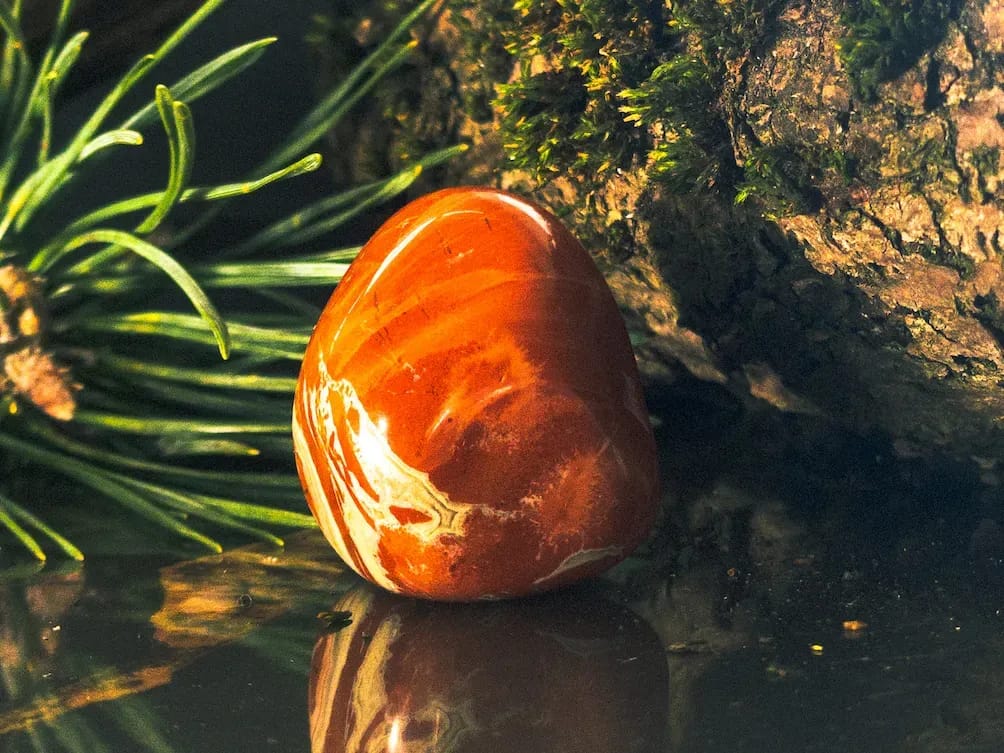
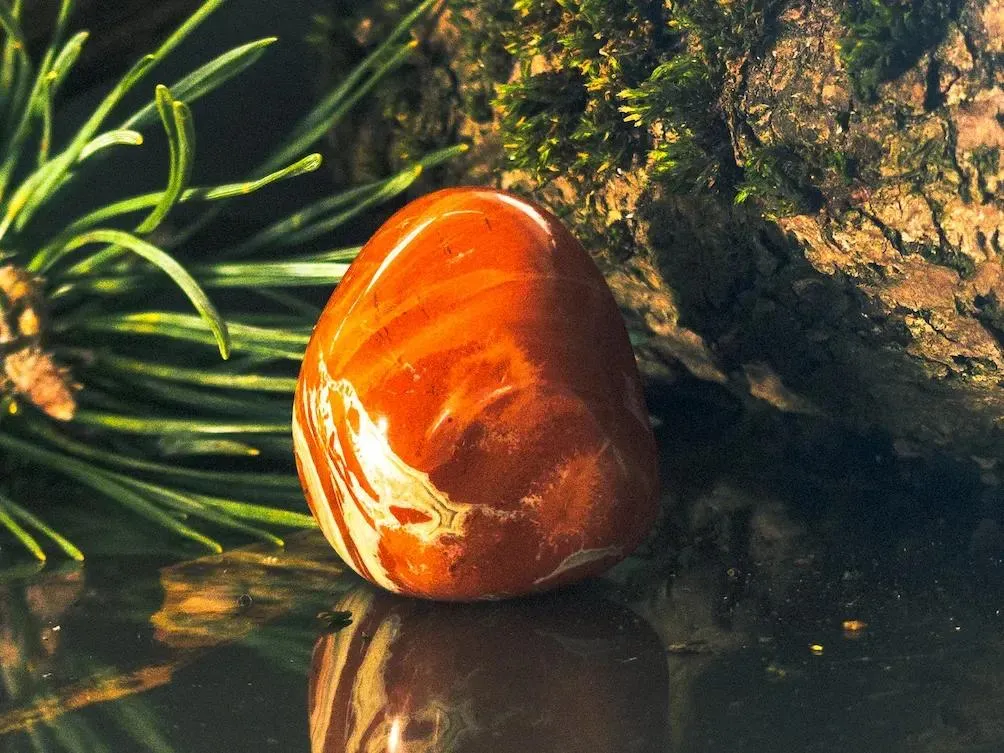
Red jasper does not need turning in search of a sudden flash. Its appeal is different: rich colour, paler lines, a polished surface. The interesting part begins when we look beyond the pattern to what lies inside the stone.
- Base material
- Fine-grained quartz · SiO₂
- Hardness
- About 7 on the Mohs scale
- Red colour
- Associated with haematite
- Transparency
- Opaque
Crystals too small to see
The International Gem Society describes jasper as an opaque, solid-coloured or patterned variety of cryptocrystalline quartz. Many tiny crystals, rather than one large crystal with distinct faces. “Cryptocrystalline” describes a structure we cannot make out without high magnification.
The British Geological Survey attributes the red colour to haematite. Its rock classification describes jasper as a red variety of chert, a siliceous rock. Quartz and colour-giving impurities meet in this story. The formula SiO₂ alone does not describe the complete composition of an individual piece.
Jasper, carnelian, agate: where is the difference?
These names sometimes overlap in gemmology. A comparison helps explain descriptions, but cannot replace examination of an individual stone.
Swipe the table sideways to see every column.
| Name | Typical description | What to notice |
|---|---|---|
| Jasper | Opaque, fine-grained quartz material | Can be solid-coloured or patterned |
| Carnelian | Red, orange-red or brownish chalcedony | Usually translucent to semi-opaque |
| Agate | A name associated with translucency or colour pattern | Red colour alone does not define it |
The researchers also stressed that jasper classifications differ between gemmology and the study of rocks. The widely used name can cover materials of different geological origins. One formation story for every jasper would therefore be misleading, and a photograph cannot establish the deposit of the Nimbas stone.
Two amulets you can find in museum collections
Specific objects tell us more about ancient use than sweeping claims. The British Museum's account of Nefer's amulet identifies red jasper and a date of about 1250–1100 BCE. The knot-shaped amulet is associated with the goddess Isis and bears Nefer's name.
According to the museum, red jasper was prescribed for this amulet in the Book of the Dead. Its protection was a belief within a religious tradition.
The Metropolitan Museum of Art in New York holds another red jasper tyet amulet: just 2.5 cm tall, dated to 664–334 BCE. Its object number is 74.51.4451. A small carving, but a concrete record of the material's use.
A polished surface and everyday care
Jasper takes a good polish, so it is often cut into cabochons or carved. Faceting is less common. Mohs hardness describes resistance to scratching; it does not promise that a dropped stone will remain intact.
- Clean gently: use warm water, a mild cleanser and a soft brush.
- Keep it in a separate soft pouch or padded compartment so stones do not rub against each other.
- Avoid household chemicals. If its treatment history is unknown, discuss steam or ultrasonic cleaning with a professional first.
IGS lists dyeing and heating as possible jasper treatments. This is general information about treatments encountered in the trade, not a claim about an individual Nimbas product.
Look at Nimbas red jasper. Follow one pale line, then return to a red patch. Sometimes getting to know a stone starts with one small difference.
Sources and further reading
- British Geological Survey – jasper and haematite colour
- International Gem Society – jasper structure, hardness and uses
- International Gem Society – chalcedony names and care
- GIA – research on jasper names and dalmatian stone
- British Museum via Google Arts & Culture – Nefer's amulet
- The Metropolitan Museum of Art – red jasper tyet amulet
- GIA – cleaning and storing jewellery