Rose quartz: the secret of its pink colour, history and love symbolism
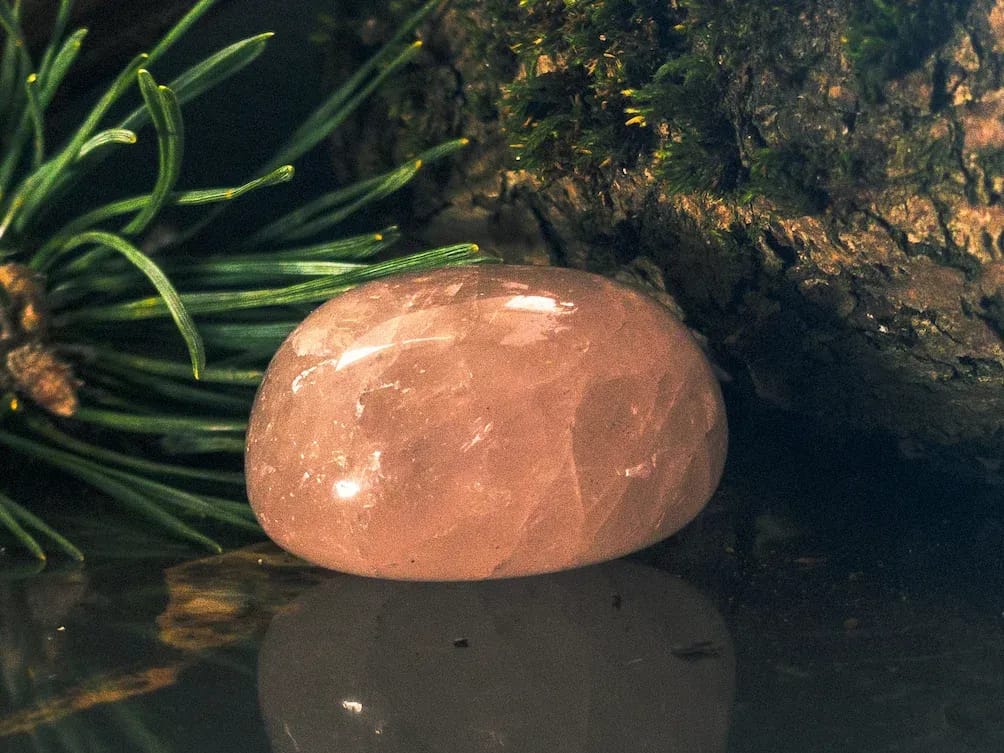
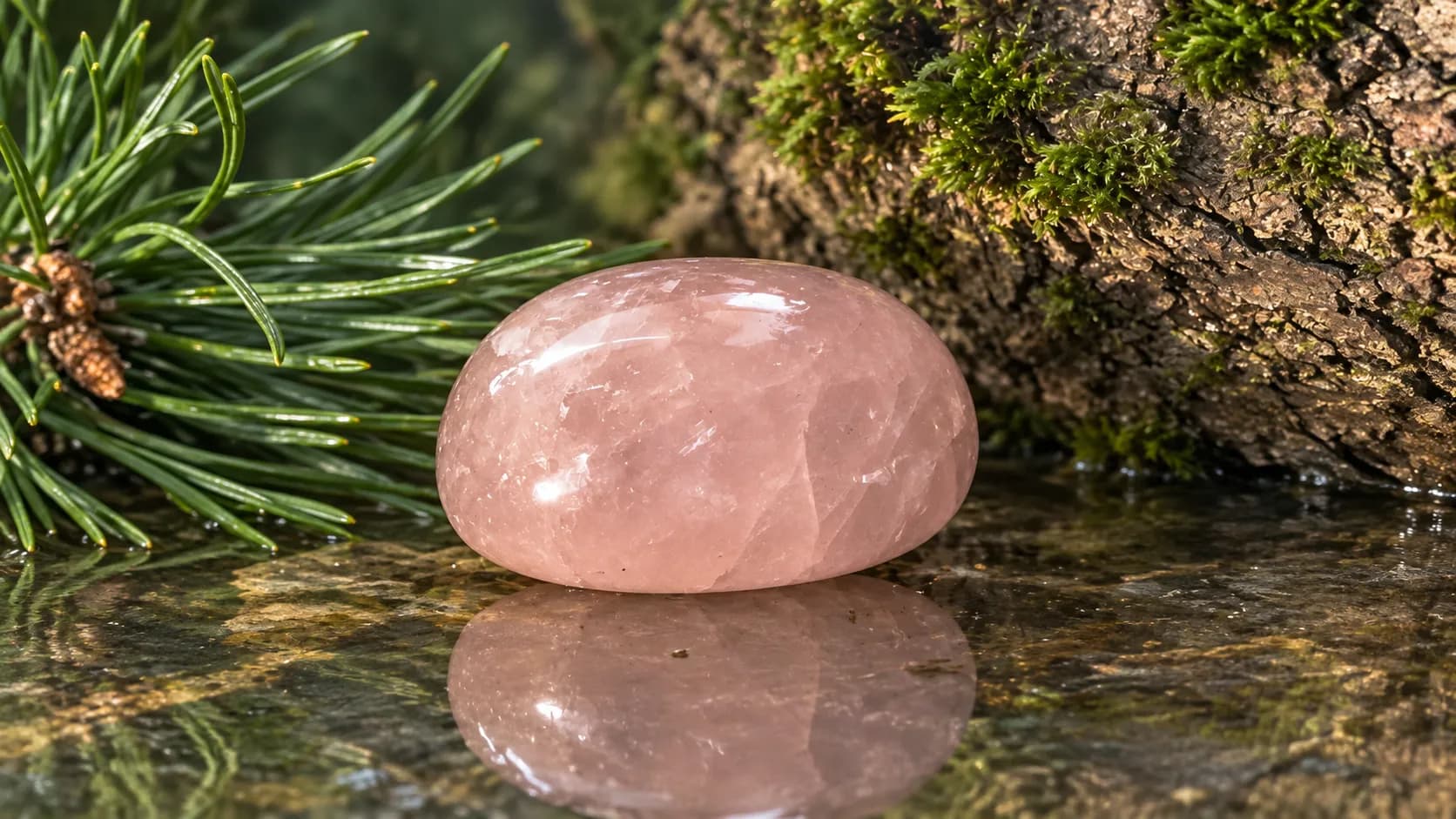
Rose quartz has a quiet appeal. Soft pink and often clouded with a milky haze, it draws you in with colour, then offers a mineral story worth looking closer at.
Why is it pink? Why do we usually see polished pieces rather than clusters of pointed crystals? And where did the name “love stone” come from?
Rose quartz at a glance
- Composition
- Silicon dioxide · SiO₂ [1]
- Hardness
- 7 on the Mohs scale [1]
- Colour
- From barely pink to deeper rose tones [1]
- Important sources
- Brazil and Madagascar [3]
Rose quartz is a variety of quartz. Mohs hardness describes scratch resistance; it does not mean a stone cannot break. GIA also recognises rose quartz as a fifth wedding anniversary gem. [1]
The pink colour starts inside
Munich’s mineral collection notes that the origin of the colour is not fully settled. However, many studies link it to microscopic fibres of a pink borosilicate related to dumortierite. Tiny mineral inclusions therefore offer a more precise explanation for ordinary rose quartz than a blanket claim about iron impurities. [2]
Where it occurs and what it looks like
Rose quartz occurs in granitic pegmatites and hydrothermal veins. Munich’s museum also presents a specimen from Hühnerkobel in Bavaria. [2]
The Smithsonian’s National Museum of Natural History describes material we usually recognise as polished stones rather than crystal clusters:
- Massive pieces are the usual form. Distinct individual crystals are rare.
- Cloudiness has its uses. This material is well suited to beads, cabochons and carvings.
- A transparent, faceted stone is a less usual sight.
Rose quartz and transparent pink quartz
A shared colour does not make every specimen the same. GIA distinguishes ordinary rose quartz from rare material sold as “pink quartz” or “pink crystalline quartz.” Their colour mechanisms differ. [4]
Swipe the table sideways to see every column.
| Feature | Ordinary rose quartz | Transparent “pink quartz” |
|---|---|---|
| Appearance | Usually cloudy. | Rare transparent material. |
| Form | Usually massive pieces. | Can form well-shaped crystal clusters. |
| Light | A fading warning should not automatically be extended to every tumbled stone. | Transparent material from some deposits fades in natural light. |
History and the “love stone” name
GIA’s historical overview records several roles for the stone:
- Assyrians made rose quartz jewellery.
- Romans used seals to mark ownership.
- Ancient Egyptians believed the stone could prevent ageing. That tells us about belief, not a proven cosmetic effect.
How to care for it
- Use warm, soapy water. This is GIA’s recommended cleaning method.
- Avoid ultrasonic and steam cleaners. GIA advises against both for rose quartz.
- Separate general information from a particular stone. Irradiation is occasionally used to intensify colour, but that does not establish whether any particular Nimbas stone has been treated.
GIA describes ordinary rose quartz as generally stable in light and heat. [6]
Rose quartz deserves a closer look for its own sake: delicate colour, cloudy interior, an occasional star and a long history of use. The meaning of a gift can be yours. The mineral story stays grounded in what we know.