Tiger’s Eye: The Shimmering Quartz of Focus, Fortitude, and Folklore
🔎 A Radiant Introduction
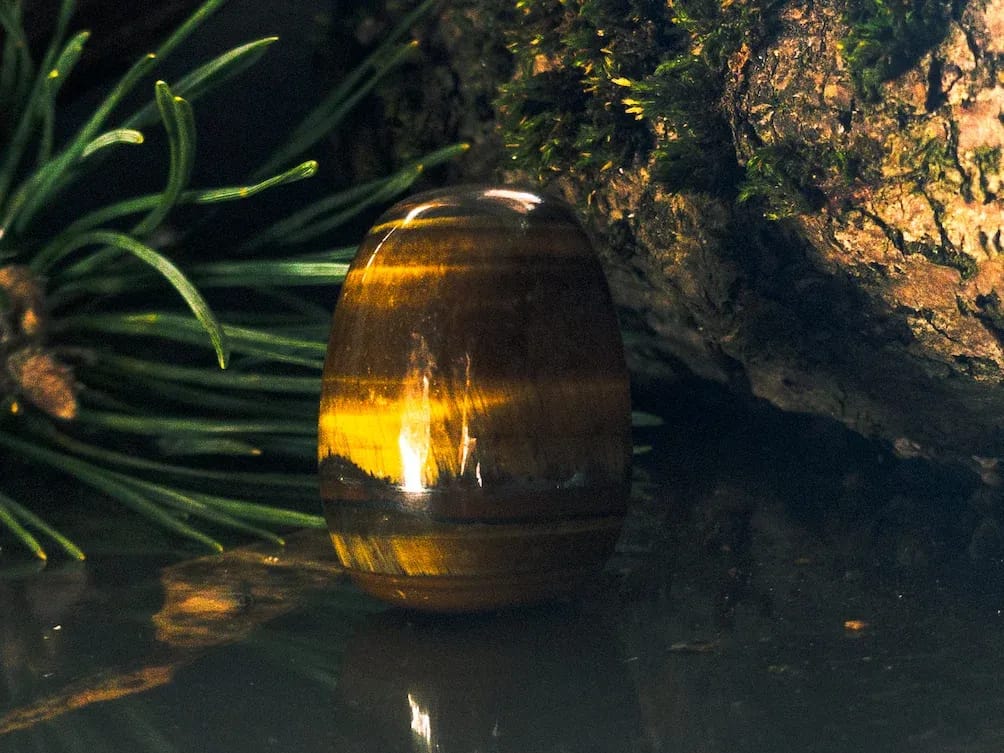
Tiger’s eye is best known for one unforgettable feature: a bright band of light that seems to glide across the stone as you tilt it. That moving “eye” is an optical effect called chatoyancy, often described as the “cat’s-eye” effect. It is the reason tiger’s eye has remained popular in jewelry, carvings, and ornamental objects for generations.
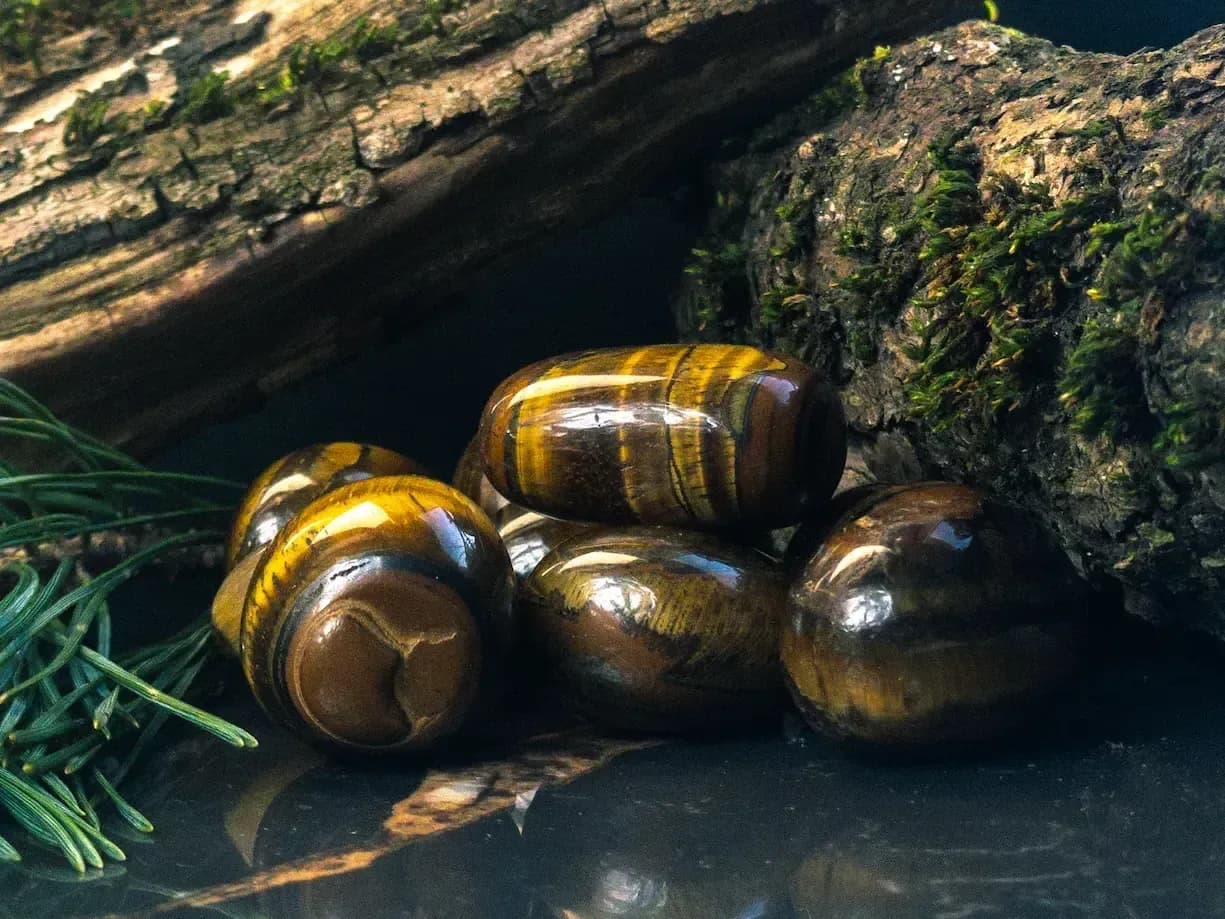
The stone usually appears in warm honey-gold, yellow-brown, or deeper brown tones, often with a silky sheen that can resemble brushed metal or polished wood. Its look has made it especially appealing in beads, rings, pendants, cufflinks, and decorative pieces.
🪨 What Tiger’s Eye Actually Is
Tiger’s eye is a chatoyant variety of quartz. In simple terms, it is quartz with a very specific internal fibrous structure that creates its moving band of light. Traditional mineral references describe it as quartz that formed in material once associated with crocidolite, a blue asbestos mineral. Over time, the silica preserved the fibrous structure that gives the stone its signature appearance.
Like quartz generally, tiger’s eye has a Mohs hardness of about 7, which makes it fairly durable for jewelry. It is strong enough for everyday wear in many settings, although it can still chip or crack if struck hard.
It is worth noting that tiger’s eye is not considered a separate mineral species. It is better understood as a distinctive quartz material defined by appearance, structure, and optical behavior.
✨ Why It Shimmers: The Science of Chatoyancy
The moving line of light in tiger’s eye is caused by many closely aligned internal fibers. When light hits those parallel fibers, it reflects in a concentrated band. As the stone moves, that band appears to shift across the surface, creating the illusion of a living eye.
This effect only shows properly when the stone is cut in the correct orientation. That is why tiger’s eye is usually shaped into a cabochon rather than faceted. The domed surface allows the optical band to appear clearly and dramatically.
This phenomenon places tiger’s eye among the group of so-called “phenomenal gems” — gemstones valued not just for color, but for special optical effects.
🧬 How Tiger’s Eye Forms — And Why Geologists Still Find It Interesting
For many years, the standard explanation was that tiger’s eye formed when crocidolite fibers were gradually replaced by silica, while preserving the original fibrous pattern. This would explain both the texture and the chatoyant effect.
More recent research has complicated that picture. A study by researchers including Peter J. Heaney and Donald M. Fisher proposed that at least some tiger’s eye may have formed through a crack-seal process instead. In that model, the host rock repeatedly fractured, mineral-rich fluids entered the cracks, and quartz and amphibole-related material formed in stages as the fractures opened and sealed over time.
That means tiger’s eye is more scientifically interesting than it first appears. It is not just a pretty stone — it is also part of an ongoing geological discussion about mineral growth, replacement, and deformation.
🌍 Where It Comes From
South Africa is the locality most strongly associated with classic tiger’s eye, especially the Northern Cape region and areas historically linked with Griqualand West. Many important deposits occur in banded iron formation, a type of rock that also contributes to the dramatic geological setting of these stones.
Studies around Prieska describe tiger’s eye occurring in lenses within folded metasedimentary rocks. The region produces not only classic golden-brown tiger’s eye, but also blue material known as hawk’s-eye and mixed varieties where the blue and golden forms occur together.
The mining history is also notable. Literature on the South African trade describes both formal and informal mining, safety concerns, and long-standing efforts to increase local cutting and polishing so that more value stays in mining communities instead of being lost through export of rough material.
📜 The Name and the Power of the “Eye”
Tiger’s eye is visually striking because it looks almost animate. That alone helps explain why people have long treated it as a meaningful or symbolic stone. The “eye” motif has deep roots across many cultures, especially in traditions involving protection, watchfulness, and warding off harm.
Early gem writer George Frederick Kunz linked eye-like stones to beliefs surrounding the “evil eye,” a widespread idea that a hostile or envious gaze can bring misfortune. Across cultures, eye-shaped amulets were often believed to reflect danger back toward the source or shield the wearer from unseen harm.
This makes tiger’s eye culturally compelling even where direct ancient evidence is thin. Once a gemstone visibly resembles an eye, it almost naturally becomes part of a symbolic world of protection, vigilance, and personal strength.
⚔️ Did Roman Soldiers Really Wear Tiger’s Eye?
One of the most repeated claims in crystal and jewelry writing is that Roman soldiers wore tiger’s eye for courage and protection in battle. The story is popular and engaging, but the evidence behind it is not especially strong.
Modern articles often repeat the claim, yet careful historical treatment suggests caution. Tiger’s eye certainly fits the symbolism of bravery and protection, but that does not automatically prove the specific Roman-soldier story in the way many modern crystal articles imply.
The safest conclusion is this: tiger’s eye has become strongly associated with courage and protection, but some of the dramatic “ancient use” stories are better treated as later lore unless supported by clear archaeological evidence.
🧿 Mystical Meaning and Modern Spiritual Use
In modern crystal traditions, tiger’s eye is often described as a stone of courage, grounded confidence, focus, practical strength, and energetic protection. It is commonly associated with helping a person stay centered under pressure, make decisions clearly, and move forward without hesitation.
Many people carry tiger’s eye as a pocket stone, wear it as jewelry, or keep it on a desk as a symbolic anchor for concentration and discipline. In spiritual practice, it is often used for stability rather than dreamy or highly emotional energy. Compared with softer mystical stones, tiger’s eye is usually framed as practical, steady, and action-oriented.
These metaphysical meanings are culturally real in the sense that people genuinely use and value them, but they are not scientifically proven medical effects. They are best understood as symbolic, spiritual, or ritual associations rather than clinical facts.
🔥 Tiger’s Eye, Hawk’s-Eye, and Red Tiger’s Eye
Not all tiger’s eye looks the same. The classic form is golden-brown, but there are related varieties worth knowing.
- Hawk’s-eye: a blue to blue-grey chatoyant variety often considered an earlier or less oxidized stage related to tiger’s eye.
- Tiger’s eye: the familiar golden to brown form associated with iron-related alteration.
- Red tiger’s eye: often sold as a natural variety, but commonly associated with heat treatment that pushes the color toward redder tones.
These related forms are part of what makes the stone family so visually appealing. They show how small changes in chemistry and treatment can shift the mood of the gem quite dramatically.
🧪 Treatments, Imitations, and What Buyers Should Watch For
Tiger’s eye is common in the gem and bead market, and that means treated and imitation material is also common. Heat treatment may be used to enhance red tones. Bleaching can lighten darker stones. Dye may be used to create more unusual or intense colors.
One widely mentioned imitation is fiber-optic glass, which can mimic chatoyancy very convincingly. These glass imitations often look extremely uniform, with a perfectly sharp band and artificial-looking colors. Natural tiger’s eye usually has more subtle variation in pattern, banding, and fiber density.
If a stone looks too perfect, too bright, or too evenly striped, it is worth asking whether it has been dyed, heated, or fully manufactured.
⚒️ A Less Talked About Reality: Dust, Mining, and Safety
Tiger’s eye is safe to own, wear, and handle as a finished polished stone. But there is an important distinction between wearing the gem and mining or cutting it.
Geological and occupational-health literature notes that some deposits occur near or with unsilicified crocidolite-bearing material, which may pose risks during extraction. More importantly, lapidary work on quartz-rich stones produces respirable silica dust. Historical medical literature documented serious silicosis cases among gemstone workers, including workers who cut tiger’s eye extensively.
That means hobbyists and professionals should treat cutting, grinding, or polishing tiger’s eye as a real dust-control issue. Wet cutting, proper ventilation, and appropriate respiratory protection matter.
🧘 Everyday Ways People Use Tiger’s Eye
Whether someone values tiger’s eye for beauty, symbolism, or spiritual meaning, it tends to fit easily into daily life. Common uses include:
- wearing it as a bracelet, pendant, or ring for a sense of grounded confidence
- keeping a small polished stone in a pocket as a tactile focus object
- placing it on a work desk to symbolize discipline, attention, and resolve
- using it during meditation as a reminder of steadiness and practical action
- including it in crystal arrangements associated with protection or motivation
Its popularity comes partly from this versatility. It feels ornamental, earthy, and symbolic at the same time.
⚖️ Why Readers Find It So Fascinating
Tiger’s eye sits at a rare intersection of science, symbolism, and aesthetics. Geologically, it is tied to unusual fibrous structure and an ongoing debate about how it forms. Visually, it produces one of the most dramatic light effects in the gem world. Culturally, it fits naturally into human ideas about sight, strength, danger, protection, and personal power.
It also has a very specific emotional tone. Amethyst often gets described as calming. Rose quartz is framed as gentle. Labradorite feels mystical and elusive. Tiger’s eye, by contrast, feels alert, grounded, and deliberate. That character is part of its appeal.
🌟 Final Thoughts
Tiger’s eye is more than a beautiful brown-gold gemstone. It is a quartz material with a remarkable internal structure, a distinctive moving band of light, a long association with protection and courage, and a surprisingly rich geological story.
Some of its most famous mystical and historical claims should be treated carefully. Its metaphysical uses are meaningful to many people, but not scientifically proven. Its ancient legends are compelling, but not all are equally well documented. Even so, the stone’s enduring popularity is easy to understand.
It looks alive. It seems to watch. And few gemstones combine natural science and symbolic power quite as effectively as tiger’s eye.