

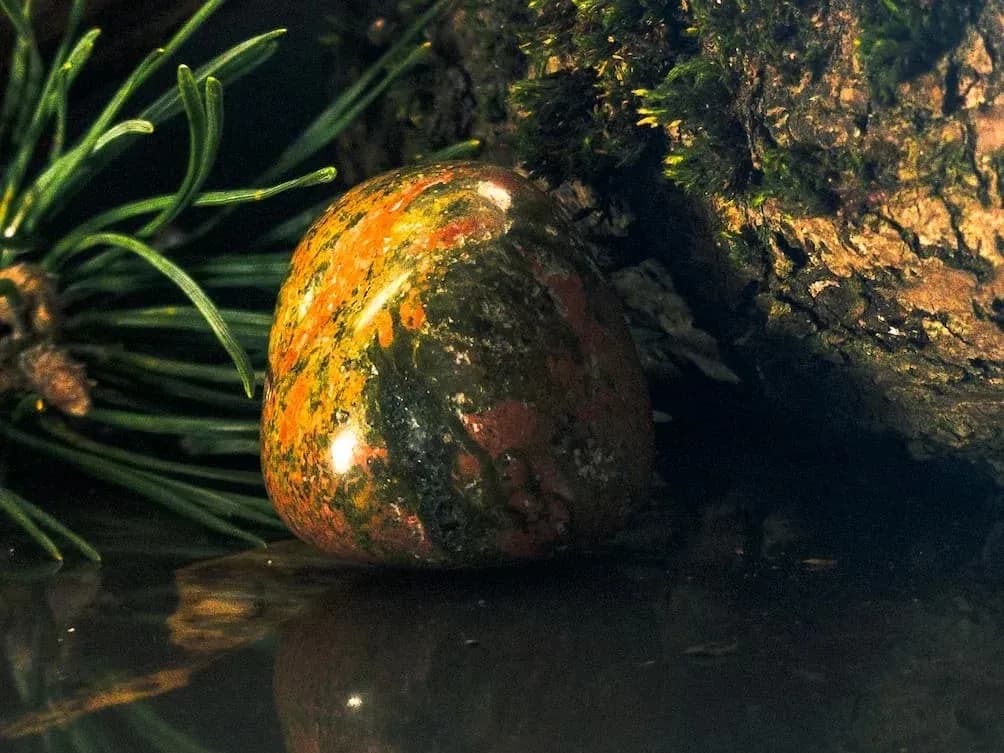
Unakite: reading a stone’s pink and green mosaic
Pink islands in a green stone. Unakite looks like a tiny mosaic, yet nobody assembled its pieces: several minerals meet here. Their combination offers a clear way to see how a rock differs from a single mineral.
- What is it?
- Altered granite or a similar rock
- Main minerals
- Epidote, orthoclase and quartz
- Recognisable pairing
- Green and pink areas
- Surface
- Takes a good polish
Three minerals in one stone
In everyday conversation, “crystal” covers many different stones. Unakite, though, is not a separate mineral species. Florida State University’s microscopy gallery describes it as epidotised granite: a rock in which epidote has formed.
Its pattern can be coarse or fine. Pink occupies larger patches in one piece; green dominates another. Geologist Hobart M. King’s cabochon photographs show how mineral proportions and grain size change the overall appearance.
Swipe the table sideways to see every column.
| Visible part | Mineral | What to notice |
|---|---|---|
| Green | Epidote | Forms the characteristic green part of the pattern |
| Pink | Orthoclase | A feldspar that contrasts with the green |
| White or grey | Quartz | A lighter constituent alongside the coloured areas |
Granite changed by hot fluids
Virginia’s geological service gives us a way to follow this story in three steps:
- Start with granite or a similar rock. Granite contains interlocking grains of feldspar, quartz and other minerals.
- Heat and hydrothermal fluids alter the rock. These changes produce the characteristic epidote, orthoclase and quartz combination.
- Later, the rock is exposed and weathers. In Virginia’s Blue Ridge Mountains, unakite resists weathering; rounded cobbles occur in rivers.
The name is linked to the Unaka Mountains. In his University of Maryland undergraduate study, Luke Councell traces it to Bradley’s 1874 description. That explains the name’s origin, rather than the origin of every unakite stone.
Why do we so often see it polished?
Unakite takes a good polish and is made into beads and ornamental objects. A smooth surface makes it easy to follow the boundaries between minerals: one patch meets another, and a single glance may not take in the whole pattern.
Treat hardness figures with care. Geology.com gives roughly 6–7 for epidote and 6 for orthoclase on the Mohs scale. These describe the scratch resistance of individual constituent minerals, not a promise that the whole stone will survive being dropped.
Look closely at Nimbas unakite. Follow a boundary between pink and green. What you see in this little stone is more than a colour: it is several minerals sharing the same space.
Sources and further reading
This article draws on geological institutions, a university study and specialist accounts of minerals and care.
- Virginia Energy – Virginia rocks and unakite formation
- Florida State University – unakite microscopy gallery
- Luke Councell, University of Maryland – undergraduate study of unakite’s hydrothermal formation
- International Gem Society – the epidote group and unakite
- Geology.com – unakite specimens, minerals and cutting
- GIA – cleaning and storing jewellery


